
How ALSONTECH 3D Vision Helps Swire Coca-Cola Tackle Reflective Beverage Depalletizing
How can Swire Coca-Cola reliably depalletize beverages wrapped in reflective plastic film?
At its Zhengzhou plant in China, this application highlights a key challenge in robotic picking: how to recognize and accurately locate beverage packs covered in reflective, transparent plastic film.
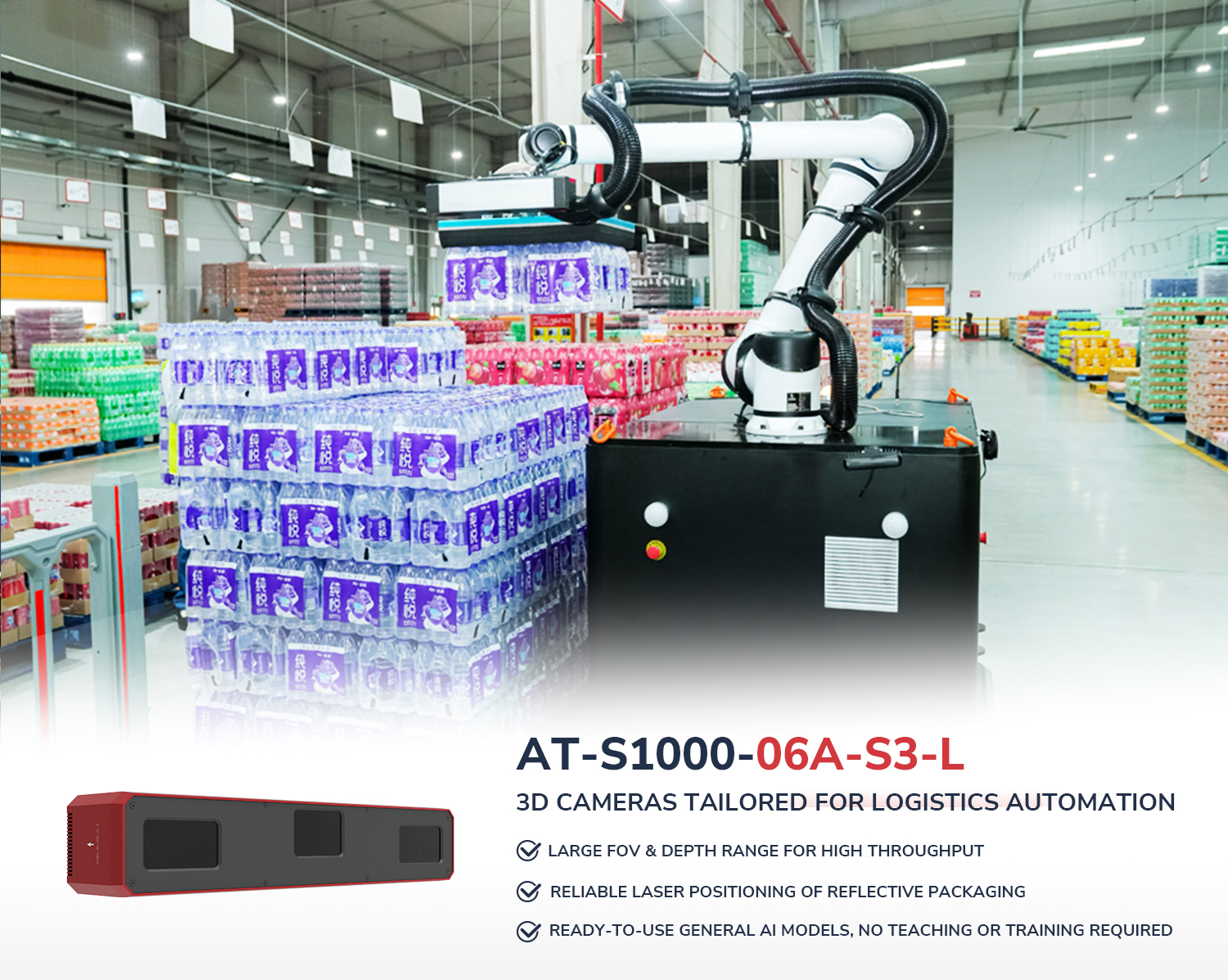
ALSONTECH's AT-S1000-06A-S3-L laser 3D camera supports this demanding application with high-quality 3D point cloud data, ready-to-use AI models, precise laser positioning, a large field of view, a compact, lightweight design, and RGB information.
Why Is Reflective Beverage Packaging Difficult for Robots to Handle?
Transparent plastic film can create reflections, wrinkles, and visual uncertainty. These factors can make beverage packs more difficult for machine vision systems to recognize and locate accurately.
For robotic depalletizing applications, robots need more than an image of the pallet. They need reliable 3D spatial information to identify individual products and determine suitable picking positions.
How ALSONTECH 3D Vision Addresses These Challenges
The AT-S1000-06A-S3-L combines six key capabilities to support challenging robotic picking applications:
- High-quality 3D point cloud data — Provides spatial data for accurate product recognition and positioning.
- Ready-to-use AI models — Eliminates the need for customer-side AI model training.
- Precise laser positioning — Helps determine suitable picking positions for individual products.
- Large field of view — Captures a wider area of the pallet scene.
- Compact, lightweight design — Supports flexible eye-in-hand robot integration while minimizing additional payload.
- RGB information — includes an RGB camera that provides RGB data, adding color information beyond the grayscale data typically provided by monochrome cameras.
Here is how each capability contributes to the application.
1. High-Quality 3D Point Cloud Data for Accurate Positioning of Reflective Beverage Packaging
The challenge: Reflections and wrinkles in transparent film can complicate product recognition and localization.
The ALSONTECH advantage: The AT-S1000-06A-S3-L captures 3D information from the pallet scene, generating point cloud data for downstream recognition and positioning.
Why it matters: High-quality 3D data provides the spatial information needed to help identify individual beverage packs and determine suitable picking positions under challenging visual conditions.
2. Ready-to-Use AI Models with No Customer-Side Training
The challenge: Developing and training AI models can add time and complexity to machine vision projects.
The ALSONTECH advantage: The camera offers ready-to-use, pre-trained AI models that require no customer-side model training.
Why it matters: This reduces the customer’s model-development burden and provides a more accessible starting point for AI-powered 3D vision deployment.
Robot integration, application configuration, and commissioning may still be required to accommodate specific production conditions.
3. Precise Laser Positioning and Wide-Area Pallet Coverage
The challenge: Robotic depalletizing requires both reliable target identification and useful position information to guide picking.
The ALSONTECH advantage: The solution combines precise laser positioning with a large field of view (FOV), capturing a wider area of the pallet while supporting product localization.
Why it matters: These capabilities help the robot obtain the spatial information needed to locate target beverage packs and guide picking operations across different pallet positions.
4. Compact, Lightweight Design for Flexible Eye-in-Hand Integration
The challenge: When a camera is mounted directly on a robot arm, its size and weight affect the overall integration design and payload. An oversized camera may interfere with the picking approach, create a collision risk, or obstruct the camera’s view of the target.
The ALSONTECH advantage: The AT-S1000-06A-S3-L combines a compact, lightweight design with a large field of view. This makes it well suited to the integrated arrangement of the camera and suction cup.
Why it matters: The camera’s compact size helps reduce interference with the suction cup during picking and lowers the risk of collision or visual obstruction caused by an oversized vision unit. Combined with its large field of view and lightweight design, it supports flexible eye-in-hand robot integration.
5. RGB Information for Logistics Applications
The challenge: In logistics applications, grayscale image data may not provide all the visual information needed when RGB data can help distinguish products, packaging, or labels.
The ALSONTECH advantage: The AT-S1000-06A-S3-L is a triple-camera system that includes an RGB camera, enabling it to provide RGB information. By comparison, a conventional monochrome camera typically provides grayscale image data.
Why it matters: RGB data adds color information to the perception results, giving logistics applications an additional visual feature that can be used alongside 3D spatial data when identifying and handling products.
6. 3D Vision Within a Coordinated Warehouse Automation System
At Swire Coca-Cola's Zhengzhou plant, robotic picking operates alongside automated guided vehicles (AGVs) under centralized AI scheduling.
The broader warehouse automation workflow connects:
- Product identification
- Robotic picking
- Automated transportation
- Mixed-pallet building
Within this setup, 3D vision provides an important perception capability for handling products with challenging packaging. The application demonstrates how machine vision can work alongside robotics, material handling, and coordinated task scheduling as part of a larger warehouse automation solution.
Bring ALSONTECH 3D Vision to Your Robotic Picking Application
Reflective packaging presents a practical challenge for robotic depalletizing. Reliable 3D data, accurate product localization, accessible AI deployment, and flexible robot integration all play important roles.
ALSONTECH's AT-S1000-06A-S3-L laser 3D camera brings these capabilities together to support demanding robotic picking applications, including beverage depalletizing.
Looking to address challenging product recognition and picking requirements in your own automation project?
Explore the AT-S1000-06A-S3-L Laser 3D Camera to learn more about its features and capabilities.


Request form (plan, case, product, contact us)
Company name*
Name*
E-mail*
Phone*
Requirements details*


