
Case Study | 3D vision-guided brake disc automatic loading solution
Brake disc is an important auto parts, is themain component of the brake system. A large auto parts manufacturing grouplayout highend production line, adopting 3D vision system to guide the robotfor automatic loading of blanks, and complete the precision processing of brake discs.
Pain Points
One brake disc is about 10Kg. By traditional manual loading, the user need to deploy many workers for repetitive handling to achieve the frequency requirements of not less than 10 pieces per minute. The back and forth transmission process is easy to produce bumps, which will affect the subsequent processing quality, and cause the risk of injury. So the user have a strong willingness to automate to reduce costs and increase efficiency.

§ At least 5kinds of blank workpiece need to be processed on site, and the front and backsides should be divided according to the incoming material situation and then grabbed and loaded separately, and new materials need to be continuously introduced according to the order demand in the later stage, and vision improvement processing flexibility needs to be introduced;
§ At present, manual forklifts are used to transport the blank frame to the loading station, which may lead out AGV in the later stage, but the parking position can not meet the accuracy requirements of the robot in the fixed position teaching and grabbing, and it is necessary to introduce vision for precise positioning;
§ In order to meet the production capacity, combined with the site layout and cost control, the vision is required to have a large field of view, a large depth offield, and can be compatible with multiple storage bins at the same time;
§ In order to ensure the smooth operation of the assembly line, high vision recognition accuracy is required to ensure that the corresponding blank is quickly loaded to the corresponding conveying forehearth and diverted to the subsequent processing process.
solution
According to the on-site station design, inorder to meet the user's loading capacity of one robot and meet the production efficiency requirements of the two processing lines, two sets ofAT-S1000-01A 3D vision system are deployed in the "one-to-two" manner, which are installed on both sides of the robot respectively, and take into account the four storage bins for rotating loading through the sliding rail installation method.
· AT-S1000-01A 3D vision camera has alarge field of view, large depth of field, and is installed at a high position to cover a large-size material frame;
· The comprehensive positioning accuracy meets the millimeter-level requirements, and the algorith moptimization eliminates lens distortion to ensure that the accuracy of the edge of the large field of view is consistent with the center;
· The 3Dvision camera adopts a laser line structured light, which can well identify the dark surface characteristics of the casting blank;
· The 3D vision camera adopts mature binocular structure design, low temperature drift, high precision output and high stability, which is more suitable for continuous operation requirements;
· The body formed by CNC integral machining has good vibration resistance, and repeated slide rail movements will not affect the structural stability.

User Benefits
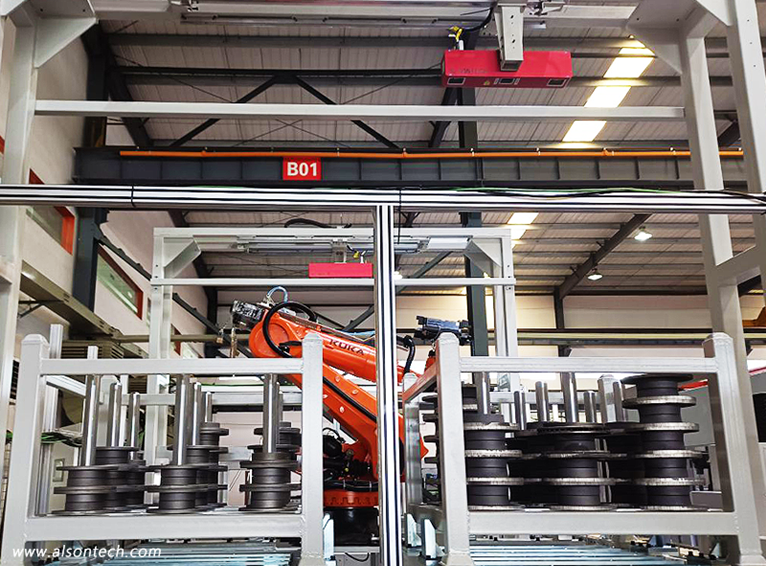
Through automation upgrading, it not only improves the processing efficiency, realizes the user's requirements for flexible production lines, but also improves the quality control level of the product and ensures that the user continues to supply qualified spare parts forfirst-class car enterprises.
· Each station adopts two camera slide raild eployment, taking into account the circular loading of four storage bins to ensure production capacity;
· Reduce the deployment of non-technical personnel, reduce operating costs and the risk of work-related accidents, and improve management efficiency;
· The 3D vision system can automatically distinguish the front and back sides of the incoming material to automatically call different gripper types;
· The 3D vision system is compatible with avariety of incoming specifications, and new materials can be continuously added according to production and order requirements, with an average introduction time of less than two hours;
· Product quality consistency is effectively guaranteed or even improved due to machine substitution, and the production line can undertake the processing tasks of higher-end products.


